What to Check Before Buying a 2013 Hyundai Elantra Replacement Engine
If you are searching for a 2013 Hyundai Elantra used engine for sale, the first priority is confirming that the replacement matches your vehicle’s exact application. A used engine can be a practical repair option when the rest of the Elantra is in suitable condition, but the purchase should be based on fitment, engine condition, mileage, donor history, included components, and warranty terms—not simply the lowest advertised price.
For U.S.-market 2013 Hyundai Elantra models, the standard powertrain used a naturally aspirated 1.8-liter four-cylinder engine. Published specifications list 1.8-liter displacement, 148 horsepower, 131 lb-ft of torque, DOHC construction, and 16 valves.
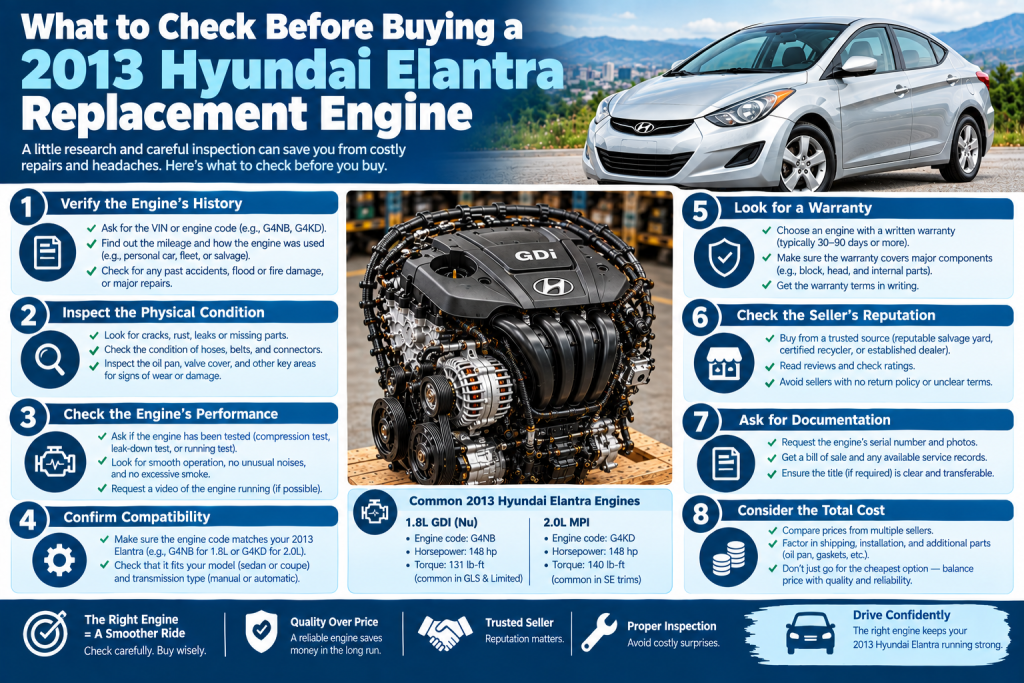
Before ordering, verify the VIN, engine configuration, emissions application, and replacement-engine identification with the seller. This is especially important because the 2013 Elantra was offered in multiple configurations, including versions with different emissions specifications.
Why Consider a Used Engine for a 2013 Hyundai Elantra?
A failed engine does not automatically mean an otherwise usable Elantra needs to be replaced.
If the transmission, body, suspension, electrical systems, interior, and other major components remain in reasonable condition, installing a replacement engine may be worth investigating.
Common situations that can lead an owner to search for a replacement include:
- Severe internal engine damage
- Excessive wear
- Major overheating damage
- Low compression
- Persistent engine knocking
- Serious oil-related problems
- Repair costs that make rebuilding the original engine less practical
- An engine that has reached the end of its serviceable condition
The important question is not simply whether a replacement engine is available. It is whether the replacement makes sense for the entire vehicle and repair budget.
2013 Hyundai Elantra Engine Specifications
Knowing the original engine specifications gives you a useful starting point when searching for replacement parts.
| Specification | 2013 Hyundai Elantra |
|---|---|
| Engine type | Gasoline inline 4-cylinder |
| Displacement | 1.8 liters |
| Valvetrain | DOHC, 16 valves |
| Valve timing | Dual CVVT |
| Standard horsepower | 148 hp |
| Standard torque | 131 lb-ft |
| Drivetrain | Front-wheel drive |
| Transmission options | 6-speed manual or automatic, depending on configuration |
These specifications are associated with standard U.S.-market configurations. California-emissions/PZEV versions had different published output, which is another reason to verify the exact vehicle before ordering.
How to Identify the Correct Used Engine
Start With the VIN
The VIN is one of the most useful pieces of information when sourcing a replacement engine.
Give the seller the complete VIN whenever possible. It can help narrow the vehicle’s specific configuration and reduce the risk of ordering an engine based only on a generic year-and-model description.
Verify the Engine Application
A listing that says “2013 Hyundai Elantra engine” may not provide enough information by itself.
Check:
- Engine displacement
- Engine identification
- Model and trim
- Body style
- Transmission
- Emissions configuration
- Donor vehicle information
- Applicable fitment details
Do not assume that every 1.8-liter Hyundai engine is interchangeable simply because the displacement is identical.
Confirm the Donor Vehicle
If the seller can provide donor information, ask where the engine came from.
Useful questions include:
- What year was the donor vehicle?
- What was its mileage?
- Why was the vehicle dismantled?
- Was it running before removal?
- Was the vehicle involved in a collision?
- Was the engine inspected after removal?
A donor vehicle’s history can provide useful context when comparing multiple used engines.
What Makes a Used Elantra Engine a Better-Documented Purchase?
Used engines can vary significantly in the amount of information supplied with them.
When comparing listings, look beyond the headline price.
Mileage
Documented mileage gives you an indication of how much use the engine had in its previous vehicle.
However, mileage should not be treated as a guarantee of condition. Maintenance history, operating conditions, storage, inspection, and previous use also matter.
Inspection Information
Ask exactly what was inspected.
Depending on the seller, available information may include:
- Compression testing
- External inspection
- Oil-condition checks
- Visible leak inspection
- Rotation testing
- General mechanical inspection
The word “tested” is not specific enough on its own. Ask what testing actually took place.
Warranty Coverage
A warranty can be an important part of comparing used engines.
Before buying, check:
- Coverage period
- Covered components
- Exclusions
- Installation requirements
- Claim process
- Return requirements
- Labor coverage, if any
- Shipping responsibility
Never assume that a warranty covers every cost associated with a replacement engine.
Used Engine vs. Rebuilt Engine
A used engine and a rebuilt or remanufactured engine are different options.
A used engine generally comes from another vehicle and is offered for reuse. Its previous mileage, maintenance, operating history, and condition depend on the individual donor unit.
A rebuilt or remanufactured engine undergoes a more extensive reconditioning process. Depending on the product, components may be inspected, machined, repaired, or replaced.
| Factor | Used Engine | Rebuilt/Remanufactured Engine |
|---|---|---|
| Source | Donor vehicle | Rebuilding process |
| Previous use | Depends on donor | Components are reconditioned |
| Mileage | Usually tied to donor | Evaluated differently |
| Inspection | Seller-dependent | Rebuilder-dependent |
| Warranty | Varies | Varies |
| Included parts | Depends on configuration | Depends on configuration |
| Overall cost | Varies | Varies |
The appropriate option depends on the vehicle, repair budget, availability, and desired warranty coverage.
What Components Come With a Used Engine?
One of the easiest ways to underestimate the total repair cost is to assume that every component shown in a photograph is included.
Used engines can be sold in different configurations.
Ask whether the replacement includes:
- Intake components
- Exhaust-related components
- Alternator
- Starter
- Sensors
- Wiring
- Fuel-system components
- Throttle-related components
- Mounting components
- Other external accessories
Some original components may need to be transferred from your existing engine. A technician should determine whether those components are suitable for reuse.
Getting a clear list of included parts before ordering can prevent surprises after delivery.
How Much Does a 2013 Hyundai Elantra Used Engine Cost?
There is no single price for a 2013 Hyundai Elantra used engine for sale.
The cost can vary based on:
- Engine mileage
- Condition
- Availability
- Inspection and testing
- Warranty
- Included components
- Shipping
- Seller policies
- Installation requirements
Instead of comparing only the advertised engine price, estimate the complete replacement cost.
Consider These Expenses
- Replacement engine
- Shipping or freight
- Installation labor
- Engine oil and filter
- Coolant and other fluids
- Gaskets and seals where appropriate
- Additional service parts
- Related repairs discovered during installation
A lower advertised price does not necessarily mean a lower final repair cost.
What Should Be Checked During Installation?
Installing a replacement engine is also an opportunity to inspect components that are difficult to access when the engine is installed.
Depending on condition, a technician may inspect:
- Engine mounts
- Cooling-system components
- Hoses
- Belts
- Electrical connections
- Sensors
- Gaskets and seals
- Spark plugs
- Fluids
- Oil and filter
The exact service items depend on the replacement engine and the vehicle’s condition.
Find the Cause of the Original Failure
This step is especially important.
If the original engine failed because of overheating, lubrication problems, a cooling-system fault, or another underlying issue, that problem should be investigated before putting the replacement engine into regular service.
Otherwise, replacing the engine may not address the root cause of the failure.
Used Engine Buying Checklist
Use this checklist before placing an order:
| Question | Why It Matters |
|---|---|
| Does it fit my exact vehicle? | Prevents compatibility problems |
| What is the engine identification? | Helps verify the application |
| What is the documented mileage? | Shows previous use |
| What vehicle supplied it? | Provides donor history |
| Was it tested? | Provides condition information |
| What components are included? | Helps calculate additional costs |
| What does the warranty cover? | Defines protection |
| What are the return conditions? | Clarifies your options if problems occur |
| How will it be shipped? | Helps plan delivery |
| What installation work is required? | Helps estimate the full repair |
People Also Ask
1. What engine does a 2013 Hyundai Elantra use?
The standard U.S.-market 2013 Hyundai Elantra used a naturally aspirated 1.8-liter four-cylinder gasoline engine. Published specifications list 148 horsepower and 131 lb-ft of torque for the standard configuration.
2. Can any 1.8-liter engine fit a 2013 Elantra?
No. Displacement alone does not establish compatibility. Engine identification, vehicle configuration, electronics, accessories, and emissions requirements should be checked before purchasing.
3. How do I find the right replacement engine?
Use the VIN, model information, engine details, and emissions configuration where applicable. Then ask the seller to confirm the exact fitment.
4. Is a used engine worth considering?
It can be an option when the rest of the vehicle remains in good condition and a compatible replacement is available with sufficient condition and warranty information.
5. What mileage is acceptable for a used Elantra engine?
There is no universal mileage cutoff. Evaluate mileage alongside donor history, inspection results, condition, and warranty coverage.
6. Does a used engine include the alternator and starter?
Not necessarily. Used engines are sold in different configurations, so the included components should be confirmed before purchase.
7. Should I use my original accessories with the replacement engine?
Some components may be transferable, but their condition and compatibility should be evaluated by a qualified technician.
Frequently Asked Questions
Is buying a used 2013 Hyundai Elantra engine cheaper than rebuilding one?
It can be, but the comparison should include labor, parts, shipping, warranty, and any machining or rebuilding costs associated with the original engine. Compare the complete repair rather than the engine price alone.
How long can a used Elantra engine last?
There is no fixed lifespan for every used engine. Remaining service life depends on mileage, maintenance history, previous operating conditions, condition at installation, and future maintenance.
Should I buy the lowest-mileage engine available?
Mileage is important, but it should not be the only consideration. An engine with clear documentation, inspection information, and appropriate warranty coverage may provide more useful information than mileage alone.
What should I ask a used-engine seller?
Ask about compatibility, engine identification, mileage, donor vehicle, inspection, testing, included components, warranty, return conditions, and shipping.
Can I install the replacement engine myself?
Engine replacement involves mechanical, electrical, cooling, fuel, and diagnostic work. The appropriate installation method depends on your experience and equipment. Professional installation can also provide an opportunity to identify related problems before the vehicle returns to service.
What if the replacement engine arrives damaged?
Document the condition immediately and follow the seller’s warranty or return procedure. Do not assume that shipping damage is handled the same way by every seller.
Should I replace fluids after installing a used engine?
Fresh fluids and filters may be appropriate as part of an engine replacement, but the exact service requirements should be determined from the replacement engine’s condition and applicable service procedures.
Final Tips for Finding the Right Elantra Engine
A search for a 2013 Hyundai Elantra used engine for sale should begin with accurate vehicle identification, not price.
Confirm the VIN and engine application. Check the donor vehicle and documented mileage. Ask what testing was performed and exactly which components are included. Read the warranty and return terms carefully, then calculate shipping and installation costs before comparing options.
It is also important to evaluate the Elantra as a complete vehicle. If its transmission, body, electrical system, suspension, and other major components remain serviceable, a replacement engine may be a practical repair to investigate.
The best purchasing process is ultimately a verification process: verify the engine, verify the condition, verify what you receive, and verify the total repair cost before ordering.